

How to Make a Fibreglass Mould

A question we are regularly asked at Tricel Composites is how to make a fibreglass mould. There are 2 options when it comes to making a mould. The easy way and the long way! Your budget, time and number of products you require, will influence your decision on this.

Before starting, make sure your working area has good ventilation and wear the appropriate personal protective equipment (PPE). For more information, please refer to the manufacturer’s MSDS and TDS for each product. If unsure about which products are most suitable, don’t hesitate to contact the Tricel Composites team who would be more than willing to help with any mould making queries.

Creating a mould from a product

When making a mould from fibreglass, a plug is used to help create the shape. The plug is the shape of the product you want your mould to create.

The first step in creating a mould from a plug is it to prep the plug! There a number of steps to this as fibreglass cannot fit around tight corners and fine details well.

Round off any sharp corners in the product, and fill in small details, cracks, or hollows using body filler or plasticine. Then, sand the part with 1000-grit wet/dry sandpaper.

If you have access to pressurised air, sometimes it is helpful to drill a small 4mm hole at the bottom of the part. You can improve demoulding by forcing pressurised air through the part once it cures. If you choose this method, cover the hole with a small sticker before applying the fibreglass. After sanding, clean the product with acetone, then buff it to a shine using 4–5 coats of Mould Release Wax (e.g., Honey Wax) and a clean white cloth.

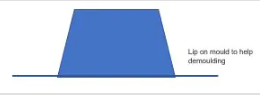
If you want a mould that will make a number of products, it is a good idea to create a lip on the outer edge of the part to aid demoulding. This can be done by fixing a sheet of laminated wood to the edge. Remember to fillet this angle.

Once you complete the prep work, measure and cut your chopped strand mat to fit over your plug, making sure to leave about 100mm of overhang on each side. Leave this to one side.

Gelcoat mixed with 2% catalyst should be applied to the part at a rate of 500g/m2. If you are using this mould to make only a couple of parts, one layer is sufficient, however, if this mould it to make a lot of parts, it is advisable to apply 3 coats of gelcoat. Allow each application of gelcoat cure before applying the next. This first two should be applied in one colour and the final layer to be applied in a different colour. In the future, when sanding as part of maintaining the mould, this will give you an indication of when you are getting close to the glass in your mould.

Once the gelcoat cures—you’ll know it’s ready when you can run your fingers across the surface without them sticking, even though it still feels tacky—use a brush to apply resin mixed with 2% catalyst over the gelcoat. Place the glass mat over the wetted-out area.

Use a brush to work more resin into the chopped strand mat, and consolidate it with a paddle roller to remove all trapped air and fully wet out the mat. Apply additional layers of fibreglass as needed—typically 4 to 6 layers, depending on the mould’s size, shape, and requirements. Use resin at 2.25 times the weight of the glass, so for 1m² of 450g mat, you’ll need 1kg of resin. Unlike gelcoat, you can apply multiple layers of resin and glass mat at once. Due to the nature of fibreglass, edges of the mould can fold inwards over time.

If you’re using the mould to produce multiple products, add ribs to the outside to help it maintain its shape. Once the resin cures completely—becoming totally rigid with no soft or wet patches—sand the part before demoulding. After sanding the cured fibreglass, carefully remove the part from the mould. Watch out for sharp strands of glass at this stage. Crack the glass ends away from the edge of the plug using a wedge and a mallet to release the part from the mould

If you had drilled the small air hole in the plug you can then use an air gun to force air into the hole which will help the mould to ‘pop’ up and release.

Trim the excess fibreglass to size, making sure to leave a lip on the mould to help with demoulding. Compound the gel-coated side of the mould to a shine. Apply three layers of wax to the mould, followed by a layer of blue release.

If you plan to use the mould for high-volume production, let it cure fully for two weeks before making products. However, you can still produce parts from it as early as the next day.

Creating a product from a mould

Ensure the mould it clean and free from dust, give a wipe with acetone on a clean cloth. This is very important as anything that is in your mould will come out on your product.

Apply mould release to the mould to make demoulding easier. However, you generally only need to do this for every fifth product. Buff the mould to a shine before use.

Use a brush to apply gelcoat at a rate of 500g/m2. This should be mixed with 2% catalyst.

After the gelcoat has cured, use a brush or a roller to apply a thin coat of resin, immediately lay the glass over the resin. Wet out the glass with more resin and consolidate with a paddle roller.

Apply more glass and resin as needed—most parts require at least three layers, and larger products may need more. Once the resin cures, sand it down using wet/dry sandpaper. If the part needs a topcoat, apply it at a rate of 500g/m². After the topcoat cures, demould the part using the same method as described earlier. Then, trim the part to the desired shape.Then you part is ready for use.

Notes for making a fibreglass mould

To ease the demoulding process, a demoulding angle of 5° should be built into the part.

A lip on the mould can also help with the demoulding process.

If you’re working with a simple shape and want to create a mould from scratch, use laminated wood to build the plug. Take care at every stage of applying gelcoat, resin, and glass to avoid trapping air bubbles, as these can shorten your mould’s lifespan or reduce the quality of the final product.

Any imperfections on the mould will come out in the product so it is a good idea to spend some time on making your mould.

Fibreglass cannot fit around tight corners and into fine detail. Round off all edges and add a radius to every corner, using a minimum radius of 10mm.

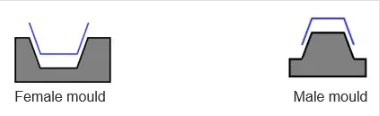
Before making your mould think about what finish you want from your product. There are two finishes in a moulded part, one with a smooth gelcoat that touches the moulds surface while moulding, and the opposite side which can be a raw glass finish or a top coated finish, this is not as smooth as the gel coated finish. This will dictate whether you want a male or a female mould.

Mould Screenshot
Mould Screenshot
Male mould - female mould screenshot

Read More...